Monday, 29 August 2016

Getting to know... Bob Dylan


A few years ago I was rooting around in the shed at my Granny’s house, looking through assorted bits and pieces left by various family members over the years, when I came across some discarded records. There were quite a few, but the ones that caught my eye were two Bob Dylan albums: Bringing It All Back Home (1965) and More Bob Dylan Greatest Hits (1971). Both have extremely striking covers, and they immediately grabbed my attention. The expression on the face of the young man on the Bringing It All Back Home cover seemed to be saying “Don’t even think about leaving me in this shed”. I am happy to say that I didn’t, and ended up becoming a huge fan. But not straight away.

When I got back home I put on Bringing It All Back Home, and the first thought that struck me was “What is this?” I had always thought of Bob Dylan as an acoustic guitar-wielding folksinger, the man who sang the song that played over the opening credits of Watchmen. But this was very different. This Bob Dylan was backed by a rollicking blues band, thrashing an electric guitar while singing a stream of strange, surreal lyrics: “Johnny’s in the basement mixin’ up the medicine/I’m on the pavement thinkin’ ‘bout the government”. What? I didn’t know what that meant, but he certainly sounded like he did. And that voice! I didn’t find it off-putting, but it was unlike any singer I had ever heard and I had no idea what to make of it. More Bob Dylan Greatest Hits provided no easy answers; a daunting 24-track melting pot of musical styles, it was far too much to take in in one listen. Fortunately, a chance encounter with the far more accessible Bob Dylan at Budoken album caused everything to fall into place, and before long I was officially a fan. Delving into Bob’s back pages, I was fascinated by the amount of stylistic changes he had gone through over the years.

Bob began as a Woody Guthrie-ish folksinger before starting to write his own songs, which ranged from moving love songs, (‘Girl from the North Country’), to goofy comedy monologues (‘Talking John Birch Society Paranoid Blues’) and austere observational songs (‘The Lonesome Death of Hattie Carroll’). By 1964 Dylan was moving away from writing songs that could be interpreted as ‘protest songs’, and his writing leaned increasingly towards the surreal, although he still retained his trademark wit (‘Motorpsycho Nitemare’) and talent for love songs (‘To Ramona’). A big change came in 1965, when Bob started using a backing band for the first time; a significant portion of his fan base apparently felt that he had ‘sold out’ in pursuit of a more commercial sound, but personally I think the extra musicians added texture and colour to his already impressive compositions. My favourite song from this period is ‘Desolation Row’, an extraordinary phantasmagoria of people and places which benefits immensely from Charlie McCoy’s sparkling guitar and Russ Savakus’ pulsating bassline, not to mention Dylan’s impassioned singing.

After an exhausting tour in 1966 to promote the album Blonde on Blonde, Bob Dylan disappeared from public view, having been injured in a mysterious motorcycle accident. For the next eight years he appeared in concert extremely rarely, and his recorded output during this period sounds like the work of a content family man enjoying a quiet yet happy life of domestic tranquillity (Bob was by this time married with children). Unfortunately this was not to last, and by 1974 rumours suggested that Dylan’s marriage was breaking down. This speculation appeared to be supported by the appearance in January 1975 of the album Blood on the Tracks, which contained numerous songs dealing with relationships ending. This album is often thought to be autobiographical, but Bob has denied this and I believe him; while elements of his personal life must surely have seeped into the record (especially on the raging ‘Idiot Wind’), Bob for the most part retains a healthy detachment as a narrator, and the gentle lightness of the music prevents the album from becoming maudlin, despite the subject matter. 

I976 saw the release of the wonderful Desire album, on which Dylan collaborated with playwright Jacques Levy to create a series of incredibly visual and cinematic story songs; pieces like ‘Hurricane’, ‘Isis’, ‘Joey’, ‘Romance in Durango’ and ‘Black Diamond Bay’ could easily be adapted into full-length motion pictures. Dylan’s personal life remained troubled, however, and the following year Bob’s wife Sara filed for divorce.

I mention this because it appears to have had a profound effect on Dylan’s music making. From 1978 onwards Bob’s songs, once so bright and outward-looking, veered increasingly towards melancholy introspection, and his voice, formerly powerful and confident, suddenly seemed strained and frail. His mood only appeared to worsen when the public rejected his conversion to born-again Christianity and a subsequent trilogy of gospel albums which, at their worst, sounded uncomfortably like a man in the throes of a total nervous breakdown. Dylan was also struggling with the recording process itself; his albums throughout the 1980s suffer from over-production, and you get the feeling that Bob had far too much time in which to second-guess himself in terms of arrangements and song selection.*

To some at the time it must have seemed that Dylan had lost his spark, but a closer examination of this period reveals that the old magic was still there. Bob’s Christian albums might have not been to everyone's taste, but the performances he gave in support of these records were incendiary; one need only listen to a recording of his performance in Toronto in 1980, for example, to dispel any suspicions about the sincerity of his conversion. In another flash of brilliance, Bob showed up for a 1984 appearance on Late Night with David Letterman with punk band The Plugz in tow. The group proceeded to tear the house down with barnstorming performances of ‘Don’t Start Me Talking’, ‘License to Kill’, and ‘Jokerman’ (during which Bob wandered off-stage to retrieve a misplaced harmonica, leaving the band and the audience to wonder where he had gone and if he was coming back).

With his record sales falling and his star in decline, Bob Dylan made two crucial decisions in 1988. The first was to join The Traveling Wilburys, a supergroup consisting of George Harrison, Roy Orbison, Tom Petty and Jeff Lynne. Working with friends in an informal environment seemed to revitalise Dylan, who turned in some terrific songs including the wonderful ‘Tweeter and the Monkey Man’, another story song that I hope is one day made into a film. The second big decision was to go on tour with a tight three-piece band, playing dozens of shows throughout the remainder of the year with a fire and energy that many had probably presumed lost forever. A big reason for the success of these shows was, in my opinion, Dylan’s hiring of GE Smith as lead guitarist and bandleader. Dylan is by many accounts an eccentric man who is at times hard to work with, but Smith genuinely seemed to like and ‘get’ Bob, and the two appear to have enjoyed playing together tremendously.

No one could have predicted it at the time, but the tour that began on 7th June 1988 is still going today, twenty-eight years later. Countless band members have come and gone, but the whole process seems to have allowed Dylan to rediscover his mojo. He still releases albums, but I get the sense that Bob thinks of himself primarily as a live performer as opposed to a recording artist. Bob uses his shows as a chance to reimagine his back catalogue; sometimes the results are poor (his diabolical 1991 tour remains infamous), but often he succeeds in successfully reinventing his songs and sometimes even eclipses the studio versions. Personally, I think something gets lost in translation when Dylan performs in the studio; from the late-70s onwards, many of Bob's songs have only really come to life when being played live on stage. A lot of his performances can be found on YouTube, and are well worth investigating.

As I hope this piece of writing shows, I have a lot of love for Bob Dylan’s songs and for the man himself, although I have never met him and have yet to see him in concert. If I did meet him, I wouldn’t ask him to sign anything or pose for a selfie; all I would really want to do is give him my sincere thanks for his music. Thanks Bob! 


* I now completely disagree with the opinions expressed in this paragraph - 12/5/2018

Friday, 5 August 2016

Star Trek II: The Wrath of Khan (1982)

STAR TREK 2 II THE WRATH OF KHAN - US MOVIE FILM WALL POSTER - 30CM X 43CM


It is difficult to fully appreciate the impact that Star Wars had upon the film industry when it was released in 1977, or the flurry of frantic activity it triggered in Hollywood as studios rushed to capitalise on its massive success. Without Star Wars we might not have witnessed the unbearable tension of Alien (1979), the twists and turns of The Empire Strikes Back (1980), or the surreal sight of James Bond engaging in an outer-space laser battle in Moonraker (1979). But perhaps the most intriguing sci-fi film to follow Star Wars was one that banked on audience nostalgia as well as the new space-craze:  Star Trek: The Motion Picture.

Unfortunately, the transition from small screen to large screen was not a smooth one for the Starship Enterprise. The Motion Picture is not without merit - the special effects and sense of epic scale remain impressive to this day – but the script was painfully low on action and often left the highly capable cast with nothing to do except literally stare into space. While the film did sufficiently well at the box office to guarantee a sequel, it was clear that drastic changes were in order. Enter director and screenwriter Nicolas Meyer.

Meyer’s philosophy for Star Trek II: The Wrath of Khan seems to have been to strip everything back to the barest essentials, and that is reflected in the streamlined plot. Khan Noonien-Singh (Ricardo Montalban), an insane, genetically engineered superman from the 20th Century who was exiled by Captain Kirk (William Shatner) to a planet named City Alpha 5 in an episode of the original series, has escaped, and wants revenge on Kirk for banishing him to a planet that subsequently became uninhabitable. He has also stolen a Starfleet ship and a potentially dangerous piece of technology called Genesis, which can create life on even the most barren of planets – or destroy life on planets that are already populated. Kirk, who is leading a crew chiefly comprised of trainees on a simple training cruise, is lured into a deadly game of cat and mouse with the unhinged yet brilliant Khan.

Star Trek II’s intention to distance itself from its ponderously-paced predecessor is made abundantly clear right from the opening scene, which is worth describing in detail. The Enterprise is under attack, and the camera pans across the bridge, which is bathed in a sinister red light. All of the familiar faces are there, all except Kirk; in the captain’s chair is Kirstie Alley’s Lieutenant Saavik. The attack on the ship intensifies and a series of explosions rock the ship, and one by one all of our favourite characters fall to the ground, apparently dead. What is happening? Where is Captain Kirk? Just then the alarms die down, the front of the bridge opens up, and there stands Kirk, visible only in silhouette. It was all just a training exercise. This one action-packed scene immediately communicates to the audience that this is going to be a very different film from The Motion Picture, and establishes a tense, claustrophobic atmosphere that remains throughout the rest of the movie. It’s flawless.

Fortunately, the rest of The Wrath of Khan lives up to this superb opening, as we are swiftly introduced to the evil villain of the title. Khan is clearly a brilliant man, but has been so consumed by his hatred for Kirk that he has gone completely mad; you really get the sense that he has spent every moment of his exile festering and stewing over what he perceives as Kirk’s betrayal of him. Ricardo Montalban gives a layered performance in what could easily have been a totally one-dimensional role, and he plays Khan with an evil relish and perverse charm that makes him a joy to watch. As good as Benedict Cumberbatch was as Khan in 2013’s Star Trek Into Darkness, you just can’t beat the original model.

But despite Montalban playing the title character, this is really William Shatner’s movie. Often unfairly written off as a shameless ham, here he gives a wonderfully understated performance that perfectly contrasts with Montalban’s more theatrical turn. A running theme of the film is Kirk coming to terms with middle-age, and this results in some great subtle moments, like the scene in which Kirk self-consciously puts on a pair of reading glasses while straining to read a computer monitor on the bridge. His final scene with Leonard Nimoy’s Spock at the film’s climax is just wonderful, and remains incredibly moving no matter how many times you see it. All of the regular cast give top-notch performances as usual, but Shatner is the heart and soul of this movie.

If the original Star Wars was a space-western, then Star Trek II: The Wrath of Khan is a space pirate movie, with the Enterprise as a naval vessel and Khan and his crew as a band of villainous rogues. Indeed, the film is replete with nautical terms and allusions, and you can even see a dog-eared copy of Moby Dick perched on Khan’s straining bookshelf. Some may prefer the films that feature more exploration and a less militaristic tone, but Star Trek II: The Wrath of Khan firmly cemented Star Trek as a big screen force to be reckoned with, and set the template that the series continues to follow to this day.

Thursday, 21 July 2016

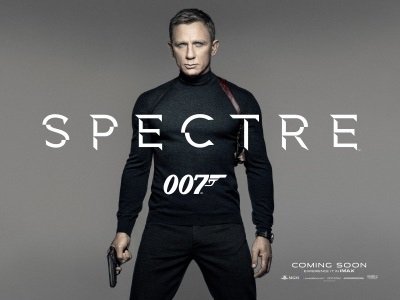
Spectre (2015)

SPECTRE - JAMES BOND 24 - Daniel Craig - US Imported Movie Wall Poster Print - 30CM X 43CM Brand New 007
Since 2006, James Bond’s primary mission has been to reinvent himself for the 21st Century, and each film since then has had a different approach to the task. Casino Royale went for a smoky, stripped-down feel; Quantum of Solace cranked up the action and drifted into Jason Bourne territory (The Bond Supremacy); and Skyfall addressed the idea of a played-out, man-out-of-time Bond going up against the alien threat of cyber-terrorism. With Skyfall director Sam Mendes returning to helm Spectre, it seemed entirely possible that the new film would simply be a re-tread of its predecessor, but – thankfully - Spectre sets out to establish its own unique identity.

We catch up with Bond (Daniel Craig) in Mexico. A message left for him by the deceased M (Judi Dench) has sent Bond to kill a criminal named Sciarra, and the subsequent funeral brings Bond face to face with Sciarra’s shadowy employers: SPECTRE. Attempting to uncover more about the organisation, Bond tracks down his old enemy Mr White (Jesper Christensen), who begs Bond to protect his daughter, Dr Madeleine Swann (Lea Seydoux), from assassination. As Bond and Madeleine are drawn closer to a showdown with SPECTRE’s mysterious leader (Christoph Waltz), they uncover a plan to unleash a dangerous new surveillance system that could threaten the very existence of MI6.

SPECTRE (Special Executive for Counter-Terrorism, Revenge and Extortion) was a fixture of the early Bond films (it featured in six of the first seven movies), which meant that this film was almost certain to cover some old ground. And it does; Spectre marks the return of several well-worn Bond hallmarks, and there are several moments that subtly recall older movies: the chase through a parade, the fight on a train, and the health clinic perched atop an Austrian mountain, to name a few. However, rather than seeming old hat, these are there simply to reassure us that this is indeed a Bond film, as Spectre takes the series down paths that none of the previous films have dared to tread.

Perhaps the most striking thing about Spectre is its atmosphere. Many Bond films have a certain unique feel about them, but none come close to the downright eeriness that permeates Spectre from the very beginning, when the familiar gunbarrell sequence fades away to reveal the words “The dead are alive” displayed on the screen. This atmosphere is sustained throughout the entire film, assisted by cinematographer Hoyte Van Hoytema’s muted colour palette. If I had to use one word to describe the overall mood of Spectre, it would be ‘funereal’.

It’s not all doom and gloom, though, and Spectre balances the darker elements with a keen sense of humour that has sometimes been missing during Daniel Craig’s tenure. Craig himself seems relaxed and comfortable in the role of Bond; it should be pointed out that this is the first time that the character of James Bond has been allowed to develop across a series of films, and watching Craig’s 007 go from a hot-headed, ruthlessly efficient young agent to a softened – if slightly curmudgeonly – middle aged Bond has been a joy. I hope he sticks around.

Elsewhere, it should come as no surprise that Christoph Waltz is playing Bond’s arch-nemesis Ernst Stavro Blofeld, who was last seen being dumped down an industrial chimney in For Your Eyes Only. It could be argued that Blofeld is most effective as an unseen presence pulling the strings from afar, but Waltz’s assured performance – which alternates effortlessly between charming and sinister – ensures that the character comes across as a genuine supervillain without straying into Dr Evil territory (no sharks with lasers attached to their heads, sadly). Lea Seydoux brings vulnerability and humanity to the part of Madeleine, and former WWE World Heavyweight Champion Dave Bautista is a natural fit for the role of hulking henchman Mr Hinx. Returning from Skyfall, Ralph Fiennes (M), Naomie Harris (Moneypenny), Ben Whishaw (Q) and Rory Kinnear (Bill Tanner) are consistently strong, while Andrew Scott (Sherlock’s Moriarty) gives an admirably restrained performance as the shifty government official Max Denbigh.

So the Bond train rolls on, defying its age to prove its continuing appeal to audiences. Spectre is by no means a perfect film – it could have been shorter, and bears signs of last-minute script tinkering – but, most importantly, it proves that the series is committed to seeking out new ground while staying true to its core values. Old dog, new tricks.

Tuesday, 28 June 2016

Whose Line is it Anyway?...Live


On Sunday 9th June I attended Whose Line Is it Anyway?...Live at the London Palladium. It was a dream come true; even though the original Whose Line TV show ended in 1998, I became aware of it when Dave (or the Top Gear channel) started airing reruns several years ago. I was hooked, and with the exception of The Simpsons I don’t think I have seen anything funnier on TV. I attended the show hoping that this live version would live up to my memories of the TV incarnation.

A bit of background: Whose Line is it Anyway? was an improvisational comedy programme that ran on Channel 4 between 1988-1998. Four performers would be called upon to act out a series of improvisation games, often based on suggestions from the audience and host Clive Anderson. Originally the show had an extremely highbrow tone (frequent panellists included Stephen Fry and John Sessions), but over time the programme leaned towards a broader, less exclusive style of comedy, which came to be embodied by series regulars Colin Mochrie and Ryan Stiles. Whose Line was such a success that it was eventually transplanted wholesale to the United States, where it can still be seen today.

The stage version of the show had been advertised as a combination of both the UK and US versions, which was fine with me as I love them both. Performing would be the incredibly quick-witted Colin Mochrie, the razor sharp Greg Proops, the wonderful Josie Lawrence, the delightful Brad Sherwood, and the effortlessly suave Jeff Davis. Clive Anderson would handle hosting duties, and the music (also improvised) would be performed by Laura Hall on piano and Linda Taylor on guitar.

Entering the grand yet surprisingly intimate London Palladium, I was interested to see that the audience was mostly made up of people under 30, many of whom (like myself) would not have been born when Whose Line first aired. Surveying the crowd, I noticed a pair of faces peeking out from a door at the side of the stage, who I recognised as series creators Mark Leveson and Dan Patterson. As the theatre gradually filled up, they looked both delighted and slightly humbled.

Before I could decide whether or not to go over and bother them with questions, the house lights dimmed, the music playing over the PA system was suddenly replaced with a live piano, and we were underway. The first thing that struck me as the performers made their way on to the stage was that none of them seemed to have aged since 1998. But it wasn't just their appearances that hadn’t changed; their comic talents had also been unaffected by the passing years. Greg and Clive reanimated their friendly US vs UK banter, and Josie, Brad and Jeff all distinguished themselves during the musical games. Colin, meanwhile, proved that he is still hilarious without Ryan Stiles, displaying superb chemistry with all the other performers. Although the show was essentially the comedy equivalent of a greatest hits parade (all the great games like Party Quirks, World’s Worst and Hoedown were played), there were some new ones (including a game called Handbags, where two audience members volunteered their handbags to the improvisers, who then used the often-embarrassing and sometimes inexplicable contents as props in a sketch), and plenty of opportunities for audience interaction.

All in all, this was a great show. The cast have been working together for decades now and clearly enjoy each other’s company, and it’s always gratifying to watch people who are the very best at what they do. The production had a suitably loose, off-the-cuff feel, replicating the rawness of the British TV show as opposed to the slickness of the American version. Also, the very nature of the show means that you could, if you wanted, go to every show and see a totally different performance each time! It’s a tempting idea, but I’m happy to wait until their next run of shows. Since Whose Line is it Anyway? clearly remains immensely popular, I‘m sure that they’ll be back sooner rather than later.


Monday, 13 June 2016

Monty Python's The Meaning of Life (1983)

Monty Python's the Meaning of Life (2 Disc Special Edition) [DVD] by Terry Gilliam


There are some things that, for whatever reason, just go together. Eggs and bacon, tea and biscuits, chips and mayonnaise (much better than ketchup). It’s especially impressive when this extraordinary degree of chemistry occurs between people, and this is undoubtedly the case with the six members of the legendary comedy troupe Monty Python. With a ground-breaking TV show (Monty Python’s Flying Circus) and two wonderful feature films (Monty Python and the Holy Grail and Monty Python’s Life of Brian) already under their belts, in 1983 Graham Chapman, John Cleese, Terry Gilliam, Eric Idle, Terry Jones and Michael Palin turned their attention to their most ambitious project yet: The Meaning of Life.

In keeping with the Python tradition of doing things the unconventional way, The Meaning of Life does not have a plot. Instead, the film is broken up into segments dealing with the different stages of life: The Miracle of Birth, Growth and Learning, Fighting Each Other, Middle Age, Live Organ Transplants (of course), The Autumn Years, and Death. It could be argued that the film suffers from the absence of a story or a central character (the straight leading parts played by Graham Chapman in Holy Grail and Life of Brian played a crucial role in anchoring the craziness), but the sketches are woven together so skilfully the that the lack of a narrative becomes a non-issue.

The sketch-based format is reminiscent of the original TV show, and, like on that show, some work better than others. However, that’s actually part of the appeal. One of the great aspects of Flying Circus was that the sketches tended to either work perfectly or fall spectacularly flat; mediocrity was not an option. Fortunately the highs vastly outnumber the lows; there are the doctors who are too busy showing off their expensive hospital equipment to pay any attention to their patient; a vicar who leads his congregation through an excessively grovelling prayer (“Forgive us for this our dreadful toadying” Congregation: “And barefaced flattery”); a one-sided boys vs schoolmasters rugby match at a terrifying boarding school; a platoon of soldiers who decide to throw their captain a surprise party in the middle of a battle; and memorable musical numbers like "The Galaxy Song" and "Every Sperm is Sacred". The Python brand of humour is sometimes taken to extremes (see the morbidly obese Mr Creosote, who vomits all over a posh restaurant before eating so much that he explodes; or a humourless schoolmaster’s alarmingly frank sex education lesson; not to mention the aforementioned Live Organ Transplants, which is exactly what it sounds like and twice as gory), but there is something liberating about the way in which the film refuses to shy away from taboo subjects like death and sex. England is famous for Not Really Talking About That Sort Of Thing, so it’s nice to get it all out in the open.

Monty’ Python’s The Meaning of Life is a glorious mess, and a last hurrah of sorts for the venerable comedy troupe. While its extremely irreverent brand of humour won’t be for everyone, you get the sense that the Pythons had a strange fondness for the various institutions that they poked fun at, and this prevents the comedy from ever seeming cruel. This underlying warmth is best displayed when the meaning of life is revealed at the end of the film:

“Well, it’s nothing special really. Try and be nice to people, avoid eating fat, read a good book every now and then, get some walking in, and try to live in peace and harmony with people of all creeds and nations.”

And that just about sums it up!

Mini-Review: The Crimson Permanent Assurance (1983)

Image result for crimson permanent assurance poster

Monty Python’s The Meaning of Life is supported by this short feature directed by Terry Gilliam, about the ageing members of a small company who decide overthrow their new owners, The Very Big Corporation of America. It’s a wonderfully imaginative swashbuckling adventure, and the special effects are still impressive more than three decades later.

Tuesday, 10 May 2016

Batman v Superman: Dawn of Justice (2016)

Batman v Superman Fight Maxi Poster, Wood, Multi-Colour


Incredibly, it’s now been nearly sixteen years since X-Men began the incredible (and somewhat exhausting) avalanche of superhero films that continues to this day. Since then, we have seen all kinds of comic book characters make the jump to the big screen, from household names like Spider-Man and The Incredible Hulk, to relative obscurities like Ant-Man and the Guardians of the Galaxy. But while the Marvel Cinematic Universe has gone from strength to strength, DC Comics has had a tougher time establishing itself as a big-screen force; it had a major success with the popular Dark Knight trilogy, but what DC really wants is a cinematic universe to call its own. Batman v Superman: Dawn of Justice is the first step towards achieving that goal, but does it stand up as a film in its own right? Let’s take a look!

After a quick run-through of Batman’s origin story (theatre, dark alley, mugger, gunshots, dead parents, well-full-of-bats, etc.) we jump forward in time to the city of Metropolis, where a helpless Bruce Wayne witnesses the destruction of a Wayne Enterprises building during Superman’s battle with General Zod from the end of Man of Steel. It’s an effective sequence that clearly establishes Batman’s issue with Superman, and we soon learn that Superman is to face a government investigation regarding his role in the destruction. Meanwhile, the villainous Lex Luthor has found some Kryptonite, and plans to use it as part of a twisted genetic experiment. Upon learning this, Batman steals the Kryptonite in order to destroy Superman once and for all, while Luthor manipulates Superman onto a collision course with the Caped Crusader.

As you can see, there’s a lot going on in this film, and I pity the poor overworked soul who had edit all of this together; not only does it need to establish a new Batman, it also aims to introduce us to the entire DC Universe, act as a sequel to Man of Steel, set up a future Justice League film, and provide a satisfying conflict between Batman and Superman. Whereas Marvel spent eight years slowly building towards a showdown between Iron Man and Captain America, Dawn of Justice has  to accomplish the same feat – and plenty of others - in just one film, and as a result the movie often feels jumbled and unfocused. There is an awkwardly place flash-forward scene in which a trench-coated Batman runs around shooting at people in a desert (?), as well as strange, shoehorned-in cameos from Aquaman and The Flash. At times it feels like the film is suffering an identity crisis, torn between being Batman v Superman or Dawn of Justice.

Happily, the last third of the film sees everything finally fall into place. Having spent the first two acts slowly (so very slowly) moving the pieces into place, the movie palpably shifts gears, cranking up the action while managing to tie all of the dangling plot threads together. This section of Dawn of Justice is truly a great spectacle, and redeems the film somewhat after the glacial pace of the early sections.

Pacing problems aside, where Batman v Superman really shines is in the performances. Ben Affleck as Bruce Wayne/Batman is superb; you really get the sense that has been worn-down by twenty years of crime fighting in the frankly hellish Gotham City. His Batman is a truly frightening creature, and the scene in which he is introduced is like something out of a horror film. So bitter and vicious is this version of the Dark Knight that you wonder whether Bruce really cares about fighting crime at all, or if hunting down criminals is simply a means for him to vent his bottomless well of rage. Superman gets slightly less attention, but comes across as a man who only sees in black and white trapped in a world of grey areas. He is genuinely trying to use his powers for good, but cannot see that the consequences of his actions can often be devastating. The star of the supporting cast has to be Gal Gadot as Wonder Woman, making the most of a small but effective role, while Amy Adams and Jeremy Irons give good performances as Lois Lane and Alfred Pennyworth, respectively. Jesse Eisenberg as Lex Luthor sometimes becomes slightly grating, but you can tell that he is totally invested in the role.

As a film in its own right, Batman v Superman is less than the sum of its parts; a collection of interesting characters and ideas presented in a strange and incoherent narrative. However, as an introduction to the DC Universe the film is much more successful. Director Zack Snyder and his team establish a world that is distinct and different from the Marvel Universe, and create endless possibilities for sequels and spinoffs (the prospect of solo films for Batman and Wonder Woman is particularly exciting). The sometimes excessively dark tone might have to be toned down in future instalments (the moment when someone finally cracks a joke, a full two hours into the film, is quite jarring), but it is good that DC is trying to find a unique identity for its films as opposed to simply aping the Marvel approach, which must have been tempting. It is entirely possible that, once the DC Universe is fully established on the big screen, we will look back on Batman v Superman: Dawn of Justice as the beginning of something truly special.


Ed McBain: Killer's Wedge (1959) and Money Money Money (2001)

  Thanks to the book exchange at my local train station (I owe them a lot of books), I recently discovered crime writer Ed McBain. Re...