Tuesday, 30 January 2018

Marc Ribot at Café Oto, 22/01/2018


Inside the Café Oto in Dalston (which really is a café by day, transforming into a music venue by night), there stood a chair, an amplifier, two microphones, and a well-used 1963 Fender Jaguar guitar. Once the 200-or-so audience members had taken their places and had time to buy drinks and chat to each other for a little while, the unassuming figure of Marc Ribot – best known for his collaborations with Tom Waits - emerged from a discreetly-placed doorway, contentedly surveyed the crowd, and passed through the room almost unnoticed, save for a few fans who spotted him and shook his hand as he made his way to the front. Once everyone in the room realised that the star of the show had arrived, a hush descended, and Ribot made his way into the spotlight with his trusty 1937 Gibson HG-00 acoustic guitar. With his shock of silver hair, grey suit jacket, and glasses perched on the end of his nose, Ribot could pass for a learned academic; which, in the field of guitar playing, you could say he is.

After the applause had died down and Ribot had thanked the audience, the guitarist set to work. The first few moments of the show reminded me of watching someone paint a picture; with the first few brushstrokes it is impossible to know where the artist is headed, but as you watch them work you start to get an idea of what they are going for. So it was with Marc Ribot: the first few notes sounded random and discordant, but gradually everything fell in to place. Hunched over his guitar, one minute Ribot would be playing a gentle jazz piece by one of his favourite composers, the next suddenly launching into a burst of frenzied improvisation, to the point where I began to wonder how much longer the strings of the battered Gibson could withstand such assaults. Occasionally a snippet of a familiar melody would emerge from the chaos, only to be instantly sucked back into the maelstrom.

For the second set, Ribot switched to his electric guitar and played a selection of pieces by the composer John Cage (after assuring the audience he wouldn't be playing any silent pieces). This section was much mellower than the frenetic opening section, but the audience remained just as enthralled. Ribot then switched back to the acoustic for some more improvised pieces, and then returned for a warmly-received encore.

I really enjoyed this show, which was intense and challenging in the best possible way. Far from being an excuse for Ribot to show off, it felt like watching someone look for something, tweaking and adjusting their work until they stand back and realise they’ve got it just right. 


Thursday, 18 January 2018

O'Donaghue's Pub, Dublin


Dublin has many, many pubs, but the one I was most excited to visit was O’Donaghue’s on Merrion Row (not to be confused with the other O’Donoghue’s on Suffolk Street).This pub is famous for being the spiritual home of traditional Irish music, and the birthplace of one of Ireland’s most famous bands, The Dubliners. It’s fair to say that, were Irish folk music a religion, O’Donaghues’s would be the place people would take pilgrimages to.

The inside of O’Donaghue’s is more or less exactly as it would have been fifty years ago. To the right of the entrance is an alcove below the front window, where in the evening you can usually count on finding a revolving cast of musicians engaged in a ‘session’, where each take turns in singing and accompanying each other in front of a huddle of reverent observers. Then there’s a narrow (and usually jam packed) thoroughfare in front of the bar which leads to a small seated section at the back, where, if you’re lucky, another session will be in progress. We were lucky, and parked ourselves directly across from the musicians, after furnishing ourselves with a pint of Guinness, of course.

The interior walls of the pub are covered from top to bottom with photographs of legendary musicians who had visited over the years; there were many pictures of Ronnie Drew, Luke Kelly and the gang, but many more of other people I didn’t know, all of whom looked like they had interesting stories to tell.

Interestingly, the musicians were all playing totally unamplified, but they appeared to be using the building’s unique acoustics to allow their singing and playing to cut through the noise from other areas of the pub. The first group we saw were a duo, one musician playing the guitar and the other a banjo, which they occasionally swapped. Their repertoire wasn’t limited to traditional tunes either, as they transformed Simon & Garfunkel’s ‘El Condor Pasa’, Johnny Cash’s ‘Folsom Prison Blues’, and The Beatles’ ‘A Day in the Life’ into ancient Irish folk songs.

On our second visit the next day, we listened to a different group headed by a singer named Victor Byrne, who sang amazing renditions of ‘The Lakes of Ponchartrain’ and ‘Caledonia’, before handing over to another singer who performed a beautiful ‘From Clare to Here’. I wasn’t familiar with these songs, but by this point I was taking copious mental notes of the songs I liked so I could look them up later. The musicians were very approachable, and glad to tell us the names of songs we didn’t know.

I will definitely coming back to O’Donaghue’s next time I’m in Dublin, and I’m looking forward to seeking out sessions at other pubs in the city. There are many, many pubs in Dublin, but I think I will be lucky to find another one as magical as O’Donaghue’s of Merrion Row.


Monday, 6 November 2017

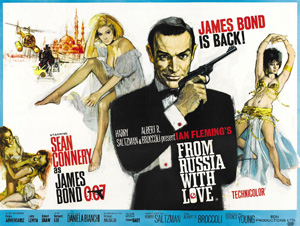
The Bond Files #2: From Russia With Love (1963)


The upper centre of the poster reads "Meet James Bond, secret agent 007. His new incredible women ... His new incredible enemies ... His new incredible adventures ..." To the right is Bond holding a gun, to the left a montage of women, fights and an explosion. On the bottom of the poster are the credits.


So, Bond is back.


He is indeed. The first film was such a success that there had to be a sequel, and there were plenty of Ian Fleming novels waiting to be adapted.


Why this one?


Well, President Kennedy had named the book as one of his ten favourite novels of all time in a 1961 issue of Life magazine. The book is also one of Fleming’s most compelling thrillers, with a really strong plot.


Is the film faithful to the book?


Mostly, with a few adjustments. For example, in the novel the Russians were the antagonists, whereas in the film Bond is up against SPECTRE, the evil organisation introduced in Dr No.


So what’s the story?


MI6 is contacted by Tatiana Romanova, a Russian cipher clerk who claims that she has fallen in love with a file photo of Bond and wants to defect, promising to hand over a cryptographic device called the Lektor in exchange for safe passage to England. Bond and M assume that this is an elaborate trap set by Russian intelligence, but it is in fact the work of SPECTRE, who have recruited Colonel Rosa Klebb as a Soviet mole.


Despite recognising the ruse, the chance of obtaining the Lektor is too great to pass up, and Bond is dispatched to Istanbul to escort Romanova back to England. Meanwhile, SPECTRE assassin Donald Grant secretly works to protect Bond’s life until he has possession of the Lektor, after which Grant intends to murder Bond (in retaliation for the death of Doctor No) and steal the device for his employers.


That’s quite intricate.


Yes, but the plot is really just an excuse for us to enter Bond’s crazy world of excitement and intrigue.


Who’s back from the last film?


Sean Connery is back as Bond, looking just as assured and comfortable as he did the first time round. If I had been alive to see From Russia With Love in 1963, I think I would have had a hard time imagining anyone else in the role. Also back are Bernard Lee as M and Lois Maxwell as Moneypenny, and we also get the first appearance of Desmond Llewellyn as Q, the legendary gadget-master.


Ooh, so does Bond get some gadgets this time?


He gets an attaché case, which contains a hidden knife and releases tear gas if not opened in a particular way. Actually, it’s the villains who get the most interesting gadgets; Grant has a garrotte wire that extends out of his wristwatch, and two of the SPECTRE agents – including Rosa Klebb – wear deadly shoes fitted with a venom coated blade. It makes sense that the villains are better equipped than Bond, since it gives him more obstacles to overcome.


Any supporting players of note?


There’s the totally charming Pedro Armendariz as Kerim Bey, Head of MI6 Station T and Bond’s contact in Istanbul. Kerim is a great character because you really believe that he and Bond are friends, thanks to the fantastic chemistry between Armendariz and Sean Connery. Sadly, Armandariz was suffering from terminal cancer during filming, and died before the film’s release. Also, Daniela Bianchi is really good as Tatiana, coming across as very genuine and sincere.


Are the villains as good as Doctor No?


Yes. This time we actually have a trio of villains: Red Grant, Rosa Klebb, and SPECTRE chief Ernst Stavro Blofeld, who at this point is a hand stroking a white cat. Lotte Lenya delivers a very effective performance as Klebb, but both she and Blofeld remain in the background for the majority of the film. Bond’s main adversary in From Russia With Love is Grant - a coldly efficient killing machine trained for the specific purpose of assassinating James Bond - played by the excellent Robert Shaw.


Henchmen in Bond films are often expected to have a gimmick of sorts, but Grant doesn’t need one; he is just a truly frightening man, casually disposing of anyone who threatens Bond’s life while relishing the prospect of murdering Bond himself. One of my favourite sequences comes in the last third of the film, when Grant masquerades as ‘Captain Nash’, a British agent sent to rendezvous with Bond. Grant’s attempts to come across as a jovial Englishman are painfully forced, and Bond’s suspicions gradually mount until Grant drops the pretence and reverts back to his natural state. It’s incredibly effective and somewhat chilling, even better for taking place aboard the Orient Express.


Are the production values still as high this time around?


Yes, the same level of care that was put into Dr No is applied here, with the same results. There appears to be a little less studio filming than there was last time, but the sets and lighting still look incredibly lavish, and the direction remains well-judged.


The title sequence is also noticeably more ambitious, and this time the credits are projected onto the bodies of belly dancers.


That’s a point: is there a theme song?


Yes: From Russia With Love, written by Lionel Bart and sung by Matt Monro. The full song is heard during parts of the film and over the end credits, and an instrumental version is used for the opening credits. A very nice song in a Frank Sinatra kind of style.


So, in conclusion?


Another really great Bond film, just as good as the last one. Again, it might have less action and stunts than people would expect from a Bond film today, but the sheer quality of the whole production makes it a must-watch.


Any random facts?


Well, Sean Connery and Robert Shaw would face off again in Robin & Marion (1976), where Shaw would play the Sherriff of Nottingham to Connery’s Robin Hood.  


Friday, 3 November 2017

The Bond Files #1: Dr No (1962)

   In the foreground, Bond wears a suit and is holding a gun; four female characters from the film are next to him.


What’s the story?

In his first ever big-screen adventure, James Bond is dispatched to Jamaica to investigate the death of a colleague, who was himself investigating a missile toppling crisis. The trail leads to the foreboding island of Crab Key, home of the mysterious Doctor Julius No.


What’s Sean Connery like as Bond?

Incredibly good, especially considering this was his first time playing the character. His Bond is a perfect mixture of charm and brutishness, with a bit of humour sprinkled in too.


How about the villain?

The villain is, of course, Doctor No, played by Joseph Wiseman. One thing I never noticed before is how little screen time Doctor No actually has, as the majority of the film is spent building suspense for his dramatic appearance in the third act. That he still manages to put in such a memorable performance is a testament to just how good Wiseman is; his commanding voice and unnerving stare serve him very well in the role, and the scene in which he and Bond verbally duel at the dinner table is a delight. He also wears a Nehru suit and lives in a luxurious underground lair, setting the standard for many a supervillain to follow.


Are there gadgets?

No, but Bond does receive a new gun from Q Branch.


Is there a theme song and title sequence?

Sort of: Dr No’s theme tune is the now iconic ‘James Bond Theme’, and it’s used a lot throughout the film. The title sequence is straightforward and low-key.


How does it stand up on a technical level?

Amazingly well. I was surprised to learn that the film didn’t have a particularly big budget, because it really looks great. The set design by Ken Adam is stunning, aided by some outstanding cinematography and lighting, and Terence Young directs with real style. There isn’t much location-hopping (the movie was filmed at Pinewood Studios and on location in Jamaica) but everything is photographed to the very highest standard.

So you’d recommend it?

Absolutely! Some might find it a bit slow compared with later films, but I enjoyed the lack of gadgets and huge stunts, as it gives the characters a bit more room to breathe. Sean Connery’s Bond is fantastic, definitely one of the most assured and confident performances I’ve seen from any actor, and the movie has a villain for the ages with Joseph Wiseman’s Doctor No. Factor in the first-rate production values and you have a real winner.


Do you have any useless trivia?

Yes. When Bond is about to sit down to dinner with Doctor No, he notices a painting on display and looks at it with an expression of shock. The painting is ‘Portrait of the Duke of Wellington’ by Francesco Goya, which had genuinely been stolen from the National Gallery in London on 21st August 1961, and was still missing at the time the film was released (hence Bond’s shock). Is that useless and trivial enough for you?


Yes.


Ed McBain: Killer's Wedge (1959) and Money Money Money (2001)

  Thanks to the book exchange at my local train station (I owe them a lot of books), I recently discovered crime writer Ed McBain. Re...